
Anthropic Said No to the Pentagon. That's the Easy Part.
Anthropic got blacklisted for refusing to let the Pentagon use Claude for autonomous weapons and mass surveillance. OpenAI filled the gap the same day. The questions this raises don't have clean answers.
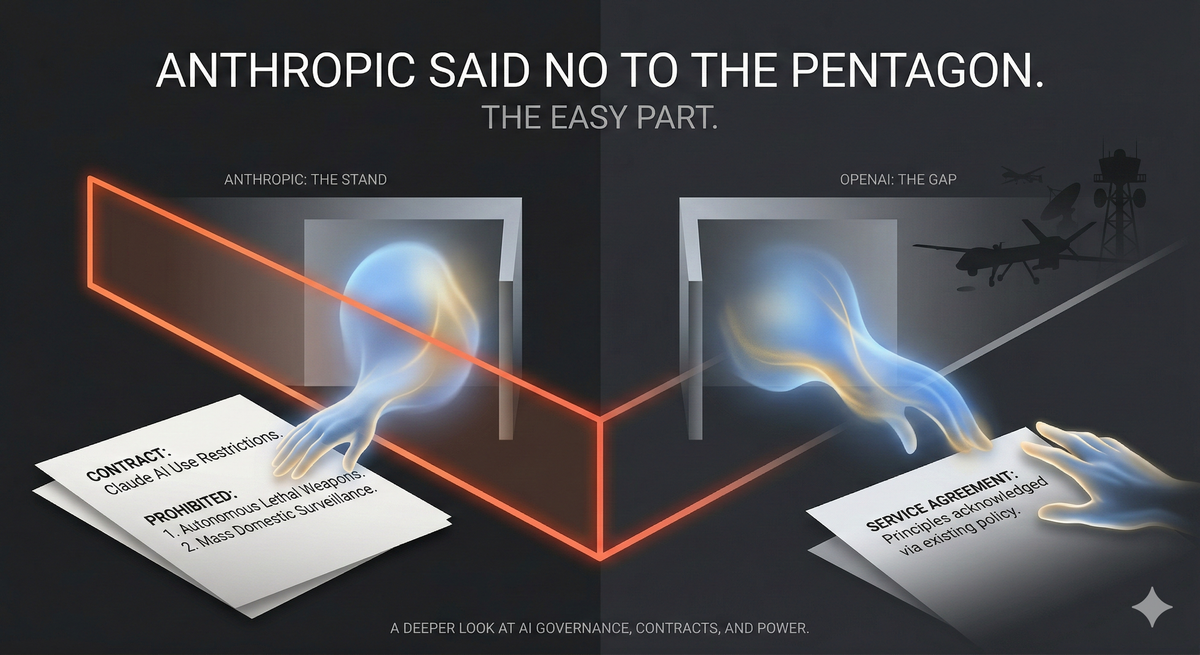
Today, the Trump administration designated Anthropic a “supply-chain risk” (the same classification reserved for Huawei and ZTE) and ordered every federal agency to immediately cease using their technology. The reason: Anthropic refused to give the Pentagon unrestricted access to Claude for fully autonomous weapons and mass domestic surveillance.
Within hours, OpenAI announced a new deal to fill the gap.
This is the most consequential AI governance event since the technology entered mainstream use, and it raises questions that don’t have clean answers. I want to work through them honestly, because the tools I use every day (including the one that helps me write on this site) are made by the company that just got blacklisted for saying no.
What Actually Happened
The facts, as reported across multiple outlets today:
Anthropic held two contractual red lines in its Pentagon deal: no fully autonomous lethal weapons (where AI, not a human, makes the final kill decision), and no mass domestic surveillance of Americans. They offered Claude for missile defense, cyber defense, and a range of intelligence tasks. The restrictions were narrow and specific.
The Pentagon demanded that Claude be available “for all lawful purposes” with no company-imposed restrictions. Even when officials verbally agreed they wouldn’t use Claude for those purposes, they refused to put it in the contract. Defense Secretary Hegseth met with CEO Dario Amodei directly and threatened contract termination and blacklisting.
Amodei’s response: “We cannot in good conscience accede to their request.”
The Pentagon set a deadline. Anthropic held its position. Trump signed an order banning all government use of Anthropic’s technology, and Hegseth designated them a supply-chain risk. That doesn’t just end the government contract, it forces every defense contractor that works with the Pentagon to cut ties with Anthropic too.
OpenAI stepped in the same day. Sam Altman stated that OpenAI holds the same two principles (no autonomous weapons, no mass surveillance) but accepted the Pentagon’s framing that these principles are “reflected in law and policy” rather than requiring explicit contract language. The Pentagon found this acceptable.
The Uncomfortable Middle
It would be easy to cast this as a simple morality play: brave company stands up to military-industrial complex. It’s not that simple.
Anthropic wasn’t refusing to work with the military. They offered Claude for missile defense and cyber defense. This isn’t pacifism. It’s line-drawing. The question is whether the lines they drew are the right ones, and whether the act of drawing them matters when someone else will erase them.
There’s also a timing problem. On the same day Hegseth delivered his ultimatum, Anthropic announced it was dropping its Responsible Scaling Policy, a two-year commitment to pause AI training if safety controls couldn’t keep up. Their stated reason: responsible developers pausing while less careful actors continued would make the world less safe, not more. The charitable reading is that these are separate issues: development pace versus deployment in weapons systems. The critical reading is that Anthropic’s safety commitments bend under competitive pressure, even if their use-case restrictions don’t.
Both readings can be true simultaneously. That’s what makes this hard.
The Enforceability Problem
The most important detail in this story isn’t Anthropic’s refusal. It’s the difference between Anthropic’s position and OpenAI’s.
Both companies claim identical principles. Both say no to autonomous weapons and mass surveillance. The difference is enforceability. Anthropic wanted these prohibitions written into the contract: legally binding, with consequences for violation. OpenAI accepted the Pentagon’s position that existing law and policy already cover it, no additional contract language needed.
Think about what that means. The government that just blacklisted a company for insisting on contractual protections is now the sole enforcer of the same principles through its own policy. Policy it can change at any time. Under an administration that has already demonstrated it will use extraordinary measures against companies that push back.
The question isn’t whether AI companies have principles. It’s whether those principles survive contact with power when the only enforcement mechanism is the goodwill of the party you’re trying to constrain.
I work in infrastructure. I’ve learned something that applies here: the difference between a policy and a control is that a control still works when someone decides to ignore the policy. A firewall rule doesn’t care about your intentions. A contract clause doesn’t care about your goodwill. What Anthropic wanted was a control. What OpenAI accepted was a policy. And in security, we have a name for systems that rely entirely on policy with no technical enforcement: we call them compromised.
The Harder Question
Everything I’ve described so far is about the United States military and American civil liberties. But the harder question isn’t about the Pentagon. It’s about everyone else.
If Anthropic won’t let the US military conduct mass surveillance of Americans, should they allow a government client in another country to use Claude for the same purpose against their own citizens? What about a country where mass surveillance is lawful? The “all lawful purposes” framing that the Pentagon demanded gets exponentially murkier when “lawful” is defined by regimes with very different conceptions of human rights.
And then there’s the question that nobody in this debate wants to answer honestly: does restraint by one company, or even one country, actually prevent the outcome?
China is building autonomous weapons systems. Russia is building surveillance infrastructure. Neither is waiting for Silicon Valley to figure out its ethics. If Anthropic refuses and OpenAI accepts, the weapons get built with OpenAI’s technology. If both refuse, the weapons get built with Chinese technology. The outcome is the same. The only variable is who profits and who has influence over how the technology is deployed.
This is the argument the Pentagon makes, and it’s not wrong on its own terms. The counterargument (that participating in the thing you’re trying to prevent undermines any moral authority to prevent it) is also not wrong. These positions are genuinely irreconcilable. Anyone who tells you there’s a clean answer is selling something.
What I keep coming back to: the fact that restraint doesn’t prevent the outcome doesn’t make restraint meaningless. It means the value of restraint is in what it says about the people exercising it, not in its strategic effectiveness. That’s a philosophical position, not a policy one. And it’s the kind of position that gets expensive when governments start issuing blacklists.
What This Means
This week, AI stopped being a technology debate and became a governance one. The question is no longer “can AI do this?” It obviously can. The question is “who decides when it should?” and the answer right now is: nobody, coherently.
Companies claim authority through acceptable use policies and contractual restrictions. Governments claim authority through law and executive orders. Users claim authority through market choice. None of these actors has legitimate authority alone, and there’s no framework that coherently balances them. What we got instead was a week of threats, ultimatums, and blacklists, which is what happens when governance questions get answered by power instead of principle.
One detail from today that I think matters more than the headlines: employees at Google and OpenAI signed an open letter supporting Anthropic’s position. Cross-company solidarity on an AI ethics question, from people who work for Anthropic’s direct competitors. The workforce may turn out to be a more durable check on AI misuse than any contract or policy. People who build the technology and understand what it can do, refusing to build it for purposes they believe are wrong. That’s a form of governance that doesn’t require anyone’s permission.
I should be transparent about my own position here: I use Claude every day. It helps me manage infrastructure, write documentation, and yes, draft posts for this blog. The company that makes the tool I rely on just got blacklisted by the US government for refusing to build weapons. I don’t know how to feel about that cleanly, and I’m suspicious of anyone who does.
No Clean Answers
I’m not going to wrap this up with a thesis statement. The situation doesn’t support one.
The Architect in me wants clean principles: these are the lines, this is why, this is what happens when they’re crossed. The realist knows that principles don’t survive geopolitics unchanged. Anthropic drew two lines and paid an enormous price. OpenAI drew the same lines and paid nothing, because they agreed to enforce them with a handshake instead of a contract. Both companies may end up in the same place. Neither approach guarantees the outcome either is hoping for.
What I can say: the people building these systems should be willing to pay a price for saying no. Not because saying no always works. It often doesn’t. But because a world where nobody is willing to say no is worse than a world where saying no is expensive. Anthropic paid that price this week. Whether it was the right call, whether it matters, whether the lines they drew were the right lines: those are questions I’ll be thinking about for a long time.
And I’ll be thinking about them using the tools made by the company that said no. Make of that what you will.